

ANDREI UJICĂ: THE MoMA RETROSPECTIVE
Updated: Aug 31
About The Event
The Romanian Cultural Institute in New York is proud to support The Museum of Modern Art’s first complete North American retrospective dedicated to Romanian filmmaker Andrei Ujică, one of contemporary cinema’s most distinctive and influential film essayists.
Bringing together works spanning more than three decades, the retrospective offers New York audiences a rare opportunity to encounter the full scope of Ujică’s cinema and his singular exploration of history, memory, politics, and the power of images. The filmmaker will be present to introduce several screenings and engage with audiences throughout the retrospective.
From his landmark films examining the collapse of communism and the Soviet Union to his deeply personal reflections on music, football, cinema, and memory, Ujică has consistently investigated the ways images shape our understanding of history—and of ourselves. His films reveal how political spectacle, mass media, and popular culture enter the collective imagination, influencing national identities, desires, fears, and personal recollection.
At a moment when artificial intelligence, rapidly evolving media platforms, and profound transformations in the production and circulation of images are challenging our confidence in what we see and what we are told, Ujică’s cinema acquires renewed urgency. His work invites us to look more carefully at images: who produces them, who controls them, what they conceal, and how they become history.
Among the highlights of the retrospective is a work-in-progress excerpt from Ujică’s latest film, Matches and Days, a meditation on the ways World Cup football has marked the rhythms of his own life and those of his son and grandchildren.
Ujică will also present his most recent feature, TWST/Things We Said Today (2024), created in collaboration with writer Geoffrey O’Brien. The film returns to New York in August 1965 and the Beatles’ legendary appearance at Shea Stadium, approaching this watershed moment in popular culture through both archival imagination and personal memory. For the teenage Ujică, then living in a Romanian village near the Yugoslav border, the Beatles offered a glimpse of another world beyond the Iron Curtain—and an early revelation of art’s capacity to cross political and geographical boundaries.
Central to the retrospective is Ujică’s celebrated trilogy examining the end of communist rule in Eastern Europe and the collapse of the Soviet Union.
In The Autobiography of Nicolae Ceauşescu (2010), Ujică constructs an extraordinary three-hour portrait from 24 years of official state images of the Romanian dictator. Working almost entirely with archival footage, the film turns the visual language of propaganda back upon itself, revealing both the mechanisms of Ceauşescu’s personality cult and the contradictions beneath the carefully staged image of political power.
Videograms of a Revolution (1992), Ujică’s seminal collaboration with Harun Farocki, examines the Romanian Revolution of December 1989 through television broadcasts and amateur video recordings. As cameras move from instruments of official authority into the hands of ordinary citizens, the film captures not only the fall of a dictatorship but also a historic transformation in the relationship between political power, media, and those who record events as they unfold.
Completing the trilogy, Out of the Present (1995) follows Russian cosmonaut Sergei Krikalev during his months aboard the Mir space station while, on Earth below him, the Soviet Union disappears. Seen from the extraordinary perspective of orbit, one of the defining geopolitical transformations of the 20th century becomes at once monumental, distant, and strangely intimate.
The program further includes 2 Pasolini (2000), which brings Pier Paolo Pasolini’s Sopraluoghi in Palestina into dialogue with the music of Tupac Shakur to reflect on the making and remaking of history; and Unknown Quantity (2005), featuring French philosopher and cultural theorist Paul Virilio and Belarusian Nobel laureate Svetlana Alexievich in an exploration of nuclear catastrophe, technological risk, fear, and the limits of human decision-making.
Together, these works reveal Andrei Ujică as a filmmaker for whom cinema is not simply a means of representing history but a way of questioning how history itself is constructed. Moving between public archives and private memories, political upheaval and popular culture, his films ask us to reconsider the images through which the 20th and 21st centuries understand themselves.
The retrospective is organized by Joshua Siegel, Curator, and Olivia Priedite, Program Coordinator, Department of Film, The Museum of Modern Art.
Support for Andrei Ujică is provided by the Romanian Cultural Institute.
The Romanian Cultural Institute in New York is honored to support this landmark presentation of Andrei Ujică’s work and to contribute to bringing one of the most important voices in Romanian and international cinema into renewed dialogue with American audiences.
Program
Matches and Days [excerpt from work in progress]. 2027. Written and directed by Andrei Ujică / TWST / Things We Said Today. 2024. Directed by Andrei Ujică
Fri, Sep 11, 7:00 p.m.
Followed by a conversation with Andrei Ujică and Geoffrey O’Brien
MoMA, Floor T2, Theater 2 / The Roy and Niuta Titus Theater 2
Wed, Sep 16, 6:30 p.m.
MoMA, Floor T2, Theater 2 / The Roy and Niuta Titus Theater 2
Videograms of a Revolution. 1992. Directed by Harun Farocki, Andrei Ujică
Sat, Sep 12, 1:00 p.m.
Introduced by Andrei Ujică
MoMA, Floor T2, Theater 2 / The Roy and Niuta Titus Theater 2
Tue, Sep 15, 6:30 p.m.
MoMA, Floor T1, Theater 1 / The Roy and Niuta Titus Theater 1
Out of the Present. 1996. Written and directed by Andrei Ujică
Sat, Sep 12, 4:00 p.m.
Introduced by Andrei Ujică
MoMA, Floor T2, Theater 2 / The Roy and Niuta Titus Theater 2
Mon, Sep 14, 4:00 p.m.
MoMA, Floor T2, Theater 2 / The Roy and Niuta Titus Theater 2
The Autobiography of Nicolae Ceaușescu. 2010. Directed by Andrei Ujică
Sat, Sep 12, 7:00 p.m.
Introduced by Andrei Ujică
MoMA, Floor T2, Theater 2 / The Roy and Niuta Titus Theater 2
Mon, Sep 14, 6:30 p.m.
MoMA, Floor T2, Theater 2 / The Roy and Niuta Titus Theater 2
2 Pasolini. 2021. Directed by Andrei Ujică
Sopralluoghi in Palestina per il vangelo secondo Matteo (Location Hunting in Palestine). 1965. Directed by Pier Paolo Pasolini
Sun, Sep 13, 1:30 p.m.
Introduced by Andrei Ujică
MoMA, Floor T2, Theater 2 / The Roy and Niuta Titus Theater 2
Tue, Sep 15, 4:30 p.m.
MoMA, Floor T1, Theater 1 / The Roy and Niuta Titus Theater 1
Unknown Quantity. 2005. Directed by Andrei Ujică
Sun, Sep 13, 4:00 p.m.
Followed by a conversation with Andrei Ujică
MoMA, Floor T2, Theater 2 / The Roy and Niuta Titus Theater 2
Wed, Sep 16, 4:30 p.m.
MoMA, Floor T2, Theater 2 / The Roy and Niuta Titus Theater 2
For more details, visit MoMA.
Venue: The Museum of Modern Art, New York
Presented by: The Museum of Modern Art
With support from: Romanian Cultural Institute
About the Films
Matches and Days [excerpt from work in progress]. 2027. Romania. Written and directed by Andrei Ujică. In Romanian; English subtitles. 12 min.
MoMA premieres a work-in-progress excerpt from Andrei Ujică’s latest project, in which the Romanian filmmaker reflects on a lifetime of watching World Cup football and sharing this passion with his son and grandchildren. “Matches and Days will be an intimate and nostalgic cinematic essay, almost like a family album,” Ujică says, “as well as a meditation on football as a mirror of the struggle for the autonomy of art. The narrative will span the peak of the Pelé project, reached in the victorious 1970 final against Italy, and the tragic failure of the next great Brazilian generation centered around Zico, Sócrates, and Falcão in 1982 and 1986.”
TWST / Things We Said Today. 2024. France/Romania. Directed by Andrei Ujică. DCP courtesy Minerva Pictures. In English, French, German; English subtitles. 86 min.
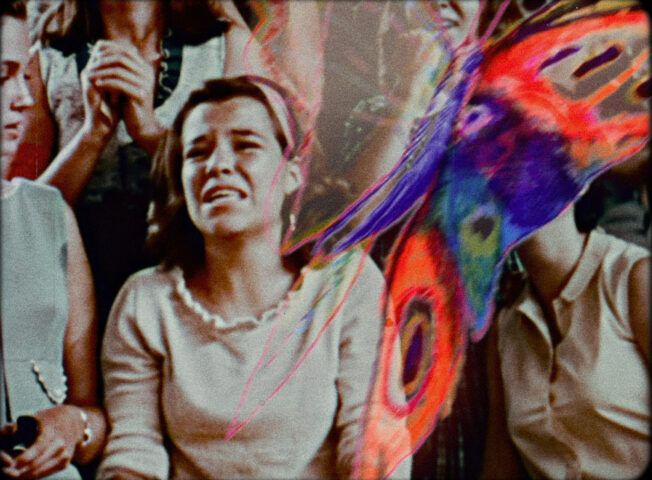
TWST | Things We Said Today is Andrei Ujică’s personal reminiscence, created in collaboration with the writer Geoffrey O’Brien, about a watershed cultural and political moment: the arrival of the Beatles in New York for their August 1965 concert at Shea Stadium, which took place against a backdrop of racial upheaval, war, and poverty in the United States. This marked an inflection point in Ujică’s life as a teenager in a Romanian village on the border with Yugoslavia, offering a transformative glimpse of freedom beyond the Iron Curtain and an epiphany about the power of art to transcend the soul-crushing drudgeries, lies, fears, and punishments of life under authoritarian rule. Frenzied images of girls attempting to storm the Beatles’ press conference at the Warwick Hotel in Midtown Manhattan are juxtaposed with television and radio news reports of police brutality and resistance in the poor, neglected Black neighborhoods of Watts and Harlem. This study in jarring contrasts is deepened by 8mm home movies, unearthed by Ujică and his researchers on eBay, of a trio of sheltered white suburban girls visiting the New York World’s Fair on the same grounds as the newly built Shea Stadium in Flushing Meadows. Excerpts from Ujică’s own short story, “Isabella, the Friend of the Butterflies”—which the filmmaker wrote as a teenager in thrall to the Beatles’ White Album—and the animated, spectral presence of our two protagonists, a then-17-year-old O’Brien and Judith Kristen, the girl in the home movies, guide us through the wild and wooly summer of ’65.
Videograms of a Revolution. 1992. Germany/Romania. Directed by Harun Farocki, Andrei Ujică. DCP. In English, German, Romanian; English subtitles. 106 min.
In Andrei Ujică’s seminal collaboration with Harun Farocki, official broadcasts of Nicolae Ceauşescu’s iron rule over Romania seem an impotent sham in the face of on-the-ground, eyewitness accounts of his dramatic demise by ordinary citizens, some of them wielding video cameras. Over five chaotic days in December 1989, street demonstrations in the western Romanian city of Timişoara erupted into violence and brutal state recrimination across the nation. Civilians occupied the national television station in Bucharest while Communist party stooges, attempting to flee or shift blame, were rounded up and put on trial. The Ceauşescus, once fêted by Queen Elizabeth, Jimmy Carter, and Kim Il Sung, were found guilty of “genocide” by an Extraordinary Military Tribunal and executed on Christmas Day. Two days later, viewers in Romania (and throughout the world) tuned in to watch incontrovertible videotape evidence of their bullet-riddled bodies. Ujică and Farocki perform a forensic study of authoritarian propaganda at a climactic moment of flameout, when reality could no longer bend to a dictator’s pernicious fiction of prosperity, progress, and international stature.
Out of the Present. 1996. Germany. Written and directed by Andrei Ujică. DCP. In Russian; English subtitles. 96 min.
Out of the Present charts the 10-month orbital isolation of Sergei Krikalev, a cosmonaut on the Mir space station who took 5,000 trips around the Earth while, back home, his native Soviet Union imploded and a rave broke out on New Year’s Eve 1991 at the Cosmonautics Pavilion at Moscow’s VDNKh, the “Permanent Exhibition of Achievements of the National Economy.” Framed through the first two sequences ever shot in space on 35mm for a feature film, with guidance from Vadim Yusov, Andrei Tarkovsky’s cinematographer on Solaris, and with allusions to 2001: A Space Odyssey and Solaris itself, Out of the Present oscillates between seriocomic scenes of Krikalev adrift in space—the flight engineer, a kind of good-humored Major Tom, attempts a life of normalcy in his zero-gravity tin-can space station, a gimcrack of exposed wires and floating detritus—and amateur footage of rioting Muscovites and tanks bearing down on the House of Soviets during the tumult of the August Coup. Within four breathless months, Mikhail Gorbachev would resign, and the dissolution of the USSR would be concluded on December 26, 1991. What lingers in the mind and eye, however, are the singular beauty of the cosmic perspective, a humanity that transcends petty politics, and “the smell of the earth…the feeling of being home again.”
The Autobiography of Nicolae Ceaușescu. 2010. Romania/Germany. Directed by Andrei Ujică. 35mm courtesy the Film Desk. In Romanian; English subtitles. 180 min.
Andrei Ujică’s magisterial film stitches together 24 years of state propaganda images of the Romanian dictator and his wife, Elena—painstakingly choreographed pageants, diplomatic visits, party congresses, and unconvincingly merry scenes of home life—into an expansive vision of a nation in thrall to, and at the mercy of, a cult leader. Drawing on archival material that inadvertently reveals moments excised from the sanctioned narrative, Ujică illuminates the fissures and tensions that would lead to the Ceauşescus’ execution by firing squad on Christmas Day 1989. As J. Hoberman observed in The New York Review of Books, “In Cannes, Ujică told interviewers that, for him, The Autobiography was a form of therapy. In effect, his first movie to be made in Romania enabled him to return to his home and reconstruct Ceauşescu’s Potemkin village from its celluloid shards. The result is as monumental as it is ephemeral, and not without a certain ghastly pathos. The misery of Ceauşescu’s dreadful misrule that is the movie’s structuring absence is amplified by the manufactured delusions foisted on a suffering nation.”
2 Pasolini. 2021. Germany. Directed by Andrei Ujică. DCP. In Italian; English subtitles. 11 min.
Sopralluoghi in Palestina per il vangelo secondo Matteo (Location Hunting in Palestine). 1965. Italy. Directed by Pier Paolo Pasolini. DCP courtesy Viggo. In Italian; English subtitles. 55 min.
Andrei Ujică uses a Tupac Shakur song and Pier Paolo Pasolini’s documentary Sopralluoghi in Palestina (Location Hunting in Palestine) (put together as research for Pasolini’s 1964 film The Gospel According to St. Matthew) to interrogate the making and remaking of history. In his journey to the Holy Land in search of “authentic” locations for his Biblical epic, Pasolini, a heterodox Marxist Catholic, was bound to find a modern landscape inhospitable to the historical presence of Christ. And yet, precisely because he ended up filming instead in southern Italy only two years after Vatican II—a seismic moment of modern Catholic self-reckoning—Pasolini’s true masterpiece is a deeply personal confrontation with ideas of liberation theology, light/faith and dark/blindness, and the role of the artist in aesthetics and spirituality. The montagist Ujică deposits several elements of violent beauty into this dialectic: Christ’s jeremiad against the Pharisees and scribes, images of a tempest-tossed sea from a pair of films by Dominique Pipat, and Tupac’s prophetic “Hit ’Em Up,” which, with lyrics like “Who shot me? But you punks didn’t finish / Now you ’bout to feel the wrath of a menace,” evokes another defiant proto-revolutionary cut down in the prime of youth.
Unknown Quantity. 2005. Germany. Directed by Andrei Ujică. With Svetlana Alexiyevich, Paul Virilio. DCP. In French; English subtitles. 67 min.
In this theatrical version of a gallery installation, the French philosopher and cultural theorist Paul Virilio and the Belarussian Nobel laureate Svetlana Alexievich, author of Voices from Chernobyl: Chronicle of the Future, grapple with the man-made tragedy of nuclear catastrophe and its implications for irrationality and fear in decision making and technological innovation. With shades of Andrei Tarkovsky’s Stalker—the heroic men and women who volunteered to contain the Chernobyl meltdown referred to themselves, in fact, as “stalkers”—Virilio and Alexievich venture into a black-box zone of epistemological and ontological uncertainty as they contend with human yearning and hubristic overreach, the myth of progress, and the awful, annihilating vastness of destruction in Chernobyl, seemingly as unfathomable as that of the atomic bombs in Hiroshima and Nagasaki, or perhaps even September 11.


